|
Research |
People |
News |
Publications |
|
Interfacial Water Group
Research Goals Interfaces between liquid water and other phases (minerals, air, carbon-rich fluids, living organisms) are ubiquitous in terrestrial natural environments. Surface chemistry and mass fluxes at these interfaces play key roles in influencing a broad range of environmental phenomena including contaminant fate and transport, metal biogeochemical cycling, multiphase flow in porous media, cloud nucleation, sediment transport, water treatment processes, and soil carbon dynamics. Our research aims to gain fundamental insight on the properties of liquid water at interfaces and in nanopores in order to understand the impact of molecular-scale properties on continuum-scale observations relevant to engineering applications. Our work combines state-of-the-art atomistic-level simulations, macroscopic scale models, and laboratory experiments. Current projects are focused on improving understanding of the complex properties of clay-rich rocks (shales, mudstones) in energy applications; mineral-organic interactions in soils and sediments; cohesive sediment transport; mudflows and other geophysical hazards; aerosol microphysics; the coupled transport properties of fluid-filled nanopores; feedbacks between fluid flow and biofilm morphology; and the role of electrical double layer (EDL) phenomena in colloidal mechanics and geophysical sensing.
Methods
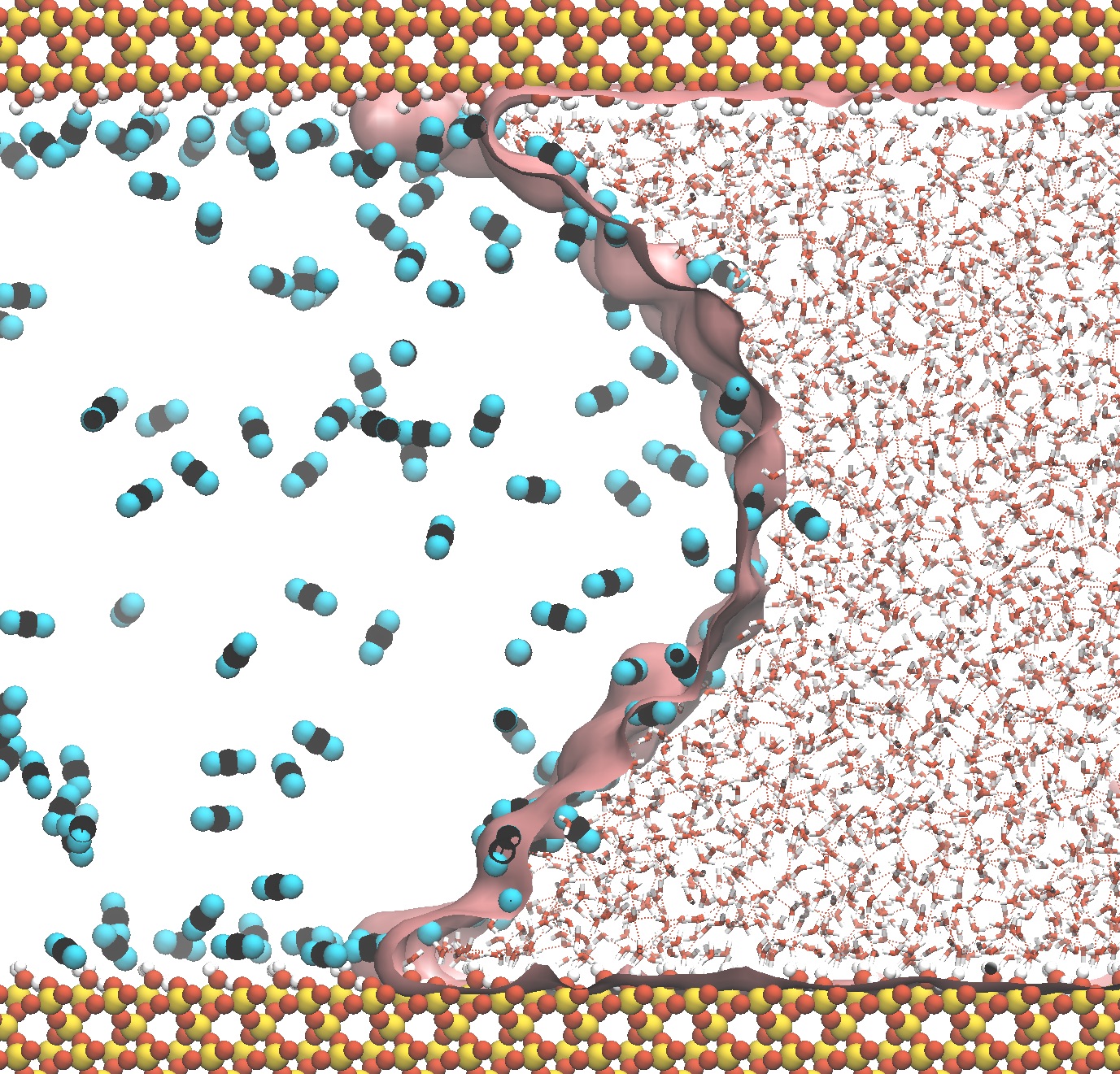
Molecular dynamics (MD) simulations are a powerful approach to gain mechanistic understanding of interfacial properties and processes. A key strength of this technique lies in its ability to probe small systems (on the order of tens of nanometers) on a broader range of time scales than any experimental method, from femtoseconds to microseconds. These simulations can reveal the behavior of individual atoms in complex systems (where spectroscopic and other experimental methods would probe the average behavior of large numbers of atoms or molecules) and the manner in which macroscopic-scale properties emerge from atomistic-level interactions. Finally, MD simulation techniques can probe interfacial systems under constraints that would be difficult or impossible to impose in the laboratory, such as fixed pore sizes, hypothetical isotopic masses, or precisely imposed non-equilibrium conditions.
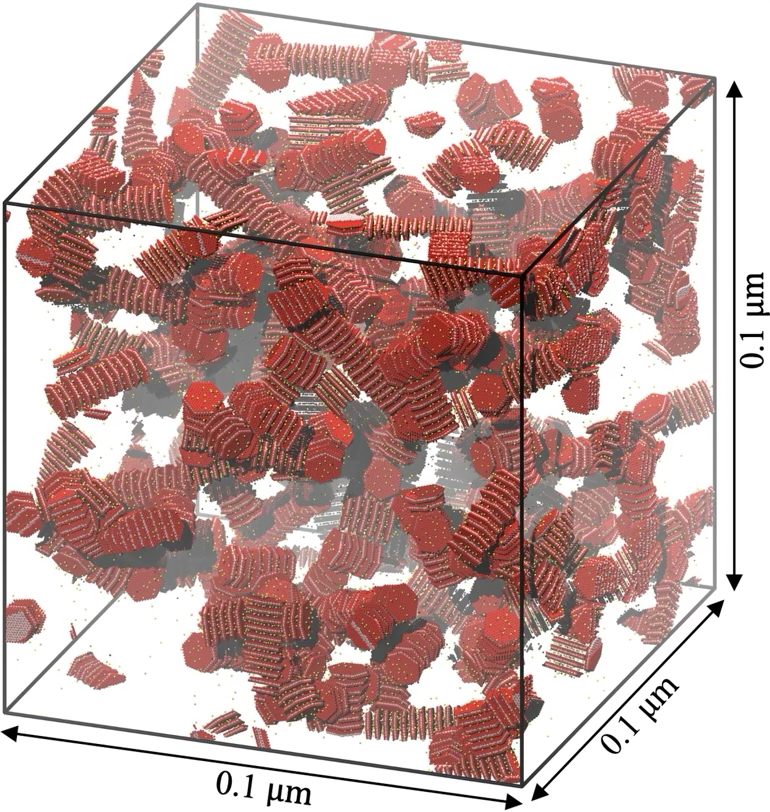
Coarse grained (CG) simulations represent molecules or nanoparticles using a reduced number of interaction sites. This enables simulating complex systems on length scales of micrometers, such as systems containing thousands of colloidal particles with explicit counterion clouds. This approach holds significant promise in elucidating the complex structure and mechanics of hierarchical materials such as assemblages charged anisotropic colloidal particles or mineral-organic assemblages. Our group has recently developed a new CG model of smectite clay minerals parameterized to match the free energy of interaction between clay particles and the distribution of counterions in clay colloidal assemblages. Results show that this model spontaneously predicts the formation of clay tactoids, the coexistence of so-called crystalline and osmotic swelling states, the length-scale dependence of clay swelling pressure, and the complex rheological properties of clay gels.
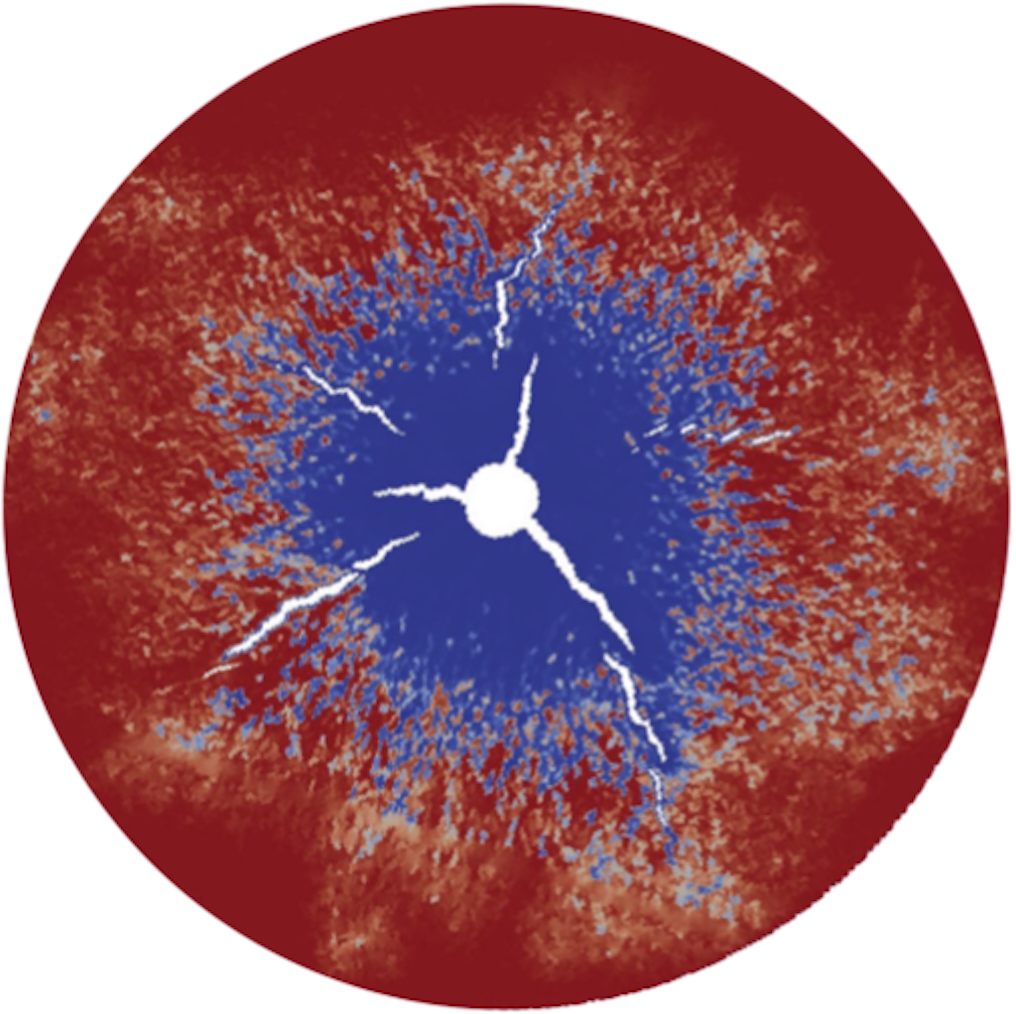
Computational fluid dynamics (CFD) simulations represent fluid flow and transport processes at the scale of individual pores (pore scale) or within unresolved porous domains (Darcy scale) using a Eulerian representation grounded in fluid mass and momemtum conservation equations. Since 2019, our group has developed a so-called micro-continuum representation, the Darcy-Brinkman-Biot framework, that enables representing fluid flow in systems that contain both free fluid domains and deformable microporous domains. This framework has shown promise in representing the soft matter physics of a variety of natural materials, including underwater mud slides, soil desiccation cracking, hydraulic or thermal fracturing of clay-rich rocks, and the deformation of biofilms under flow.
|